

Premium, high-sensitivity semiquantitative test strips specifically engineered to identify trace and residual amounts of Hydrogen Peroxide H2O2 in chemical processing, medical cleaning, and pure water lines. Providing distinct, ultra-sensitive colorimetric
1. Introduction
In various industries and applications, monitoring the concentration of hydrogen peroxide (H₂O₂) in water is of utmost importance. Hydrogen peroxide is widely used as a disinfectant, bleaching agent, and in many industrial processes. However, improper levels of hydrogen peroxide in water can have significant implications, ranging from ineffectiveness in disinfection to potential harm to living organisms and materials. This is where disinfectant peroxide test strips, also known as peroxide test strips or H₂O₂ hydrogen peroxide test strips, come into play. These test strips, along with peroxide test kits and H₂O₂ disinfection test kits, are essential tools for quickly and accurately assessing the hydrogen peroxide content in water.
2. Understanding Hydrogen Peroxide in Water
Hydrogen peroxide is a chemical compound with the formula H₂O₂. It is a pale blue liquid in its pure form but appears colorless in dilute solutions. It is a strong oxidizing agent, which makes it effective in killing bacteria, viruses, and other microorganisms. In the water treatment industry, hydrogen peroxide is used for disinfection purposes. It can break down into water and oxygen, leaving no harmful residues. In addition to disinfection, it is used in pulp and paper bleaching, textile processing, and in the production of various chemicals.
Disinfection Efficacy: In water treatment plants, maintaining the correct concentration of hydrogen peroxide is crucial for effective disinfection. If the concentration is too low, it may not be able to kill all the harmful pathogens, leading to potential health risks. On the other hand, if the concentration is too high, it can cause damage to pipes, equipment, and aquatic life if the water is discharged into natural water bodies.
Industrial Process Control: In industries such as food and beverage, pharmaceuticals, and electronics, hydrogen peroxide is used in various manufacturing processes. Precise control of its concentration in water used in these processes is necessary to ensure product quality and safety. For example, in the production of bottled water, the right amount of hydrogen peroxide for disinfection is required to meet strict quality standards.
3. How Disinfectant Peroxide Test Strips Work
Disinfectant peroxide test strips are based on a simple yet effective chemical reaction. The test strip contains a reagent that reacts specifically with hydrogen peroxide in the water sample. When the test strip is dipped into the water containing hydrogen peroxide, the hydrogen peroxide oxidizes the reagent on the strip. This oxidation reaction causes a color change on the test strip. The intensity of the color change is proportional to the concentration of hydrogen peroxide in the water.
Reagent - Impregnated Pad: The key component of the test strip is the reagent - impregnated pad. This pad is usually made of a porous material such as filter paper that has been impregnated with a chemical reagent. The reagent is carefully selected to have a high specificity for hydrogen peroxide. Common reagents used in these test strips include certain organic dyes or compounds that can be oxidized by hydrogen peroxide to produce a visible color change.
Backing Material: The reagent - impregnated pad is attached to a backing material, which provides support and stability to the test strip. The backing material is often made of a plastic or paper - like material that is resistant to water and does not interfere with the chemical reaction on the pad.
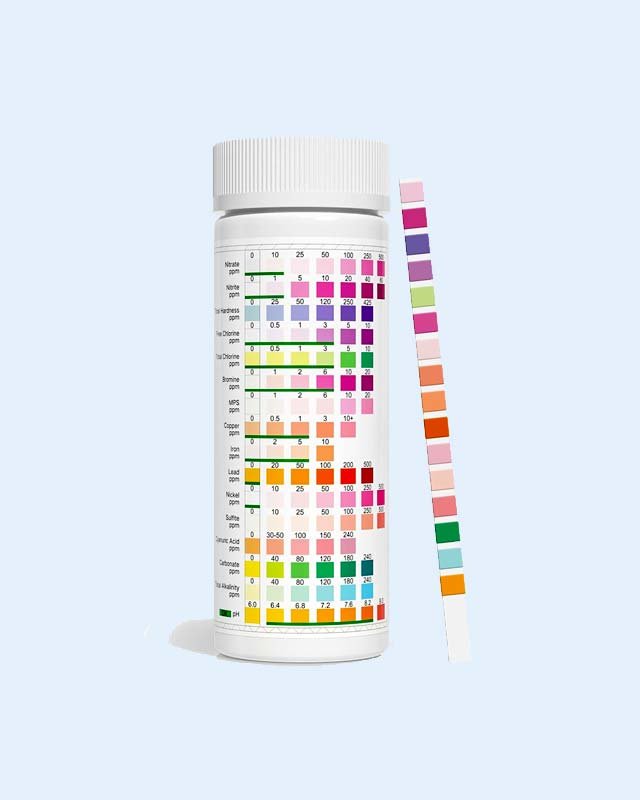
Once the test strip has been dipped into the water sample and the color change has occurred, the user compares the color of the test strip with a color - comparison chart provided with the test strips. The color - comparison chart is calibrated to show the corresponding hydrogen peroxide concentrations for each color on the chart. By matching the color of the test strip to the closest color on the chart, the user can quickly determine the approximate concentration of hydrogen peroxide in the water. Some more advanced test strips may also have a numerical scale printed on the strip itself, allowing for a more precise reading.
4. Types of Peroxide Test Strips
Single - range test strips are designed to detect hydrogen peroxide within a specific concentration range. For example, there may be test strips that are optimized to detect hydrogen peroxide concentrations between 0 - 100 ppm (parts per million). These test strips are useful when the expected hydrogen peroxide concentration in the water sample is known to fall within a relatively narrow range. They offer high accuracy within their specified range and are often more sensitive to small changes in concentration within that range.
Multi - range test strips, on the other hand, can detect hydrogen peroxide over a wider range of concentrations. These test strips typically have multiple reagent - impregnated pads or sections, each designed to react to a different concentration range. For instance, a multi-range test strip may be able to detect hydrogen peroxide concentrations from 0 - 10 ppm in one section and from 10 - 1000 ppm in another section. This makes them more versatile, as they can be used in situations where the hydrogen peroxide concentration in the water sample is unknown or may vary widely.
5. Advantages of Using Peroxide Test Strips
One of the major advantages of peroxide test strips is their simplicity. Even individuals with no prior knowledge of chemistry or water testing can easily use these test strips. The process involves simply dipping the test strip into the water sample and comparing the color change with the provided chart. There is no need for complex equipment or elaborate procedures, making it a convenient option for on - site testing in various settings, such as water treatment plants, industrial facilities, or even in households for testing water used in aquariums or for cleaning purposes.
Peroxide test strips provide rapid results. In most cases, the color change occurs within a few seconds to a minute after dipping the test strip into the water sample. This quick turnaround time is extremely valuable in situations where immediate decisions need to be made, such as adjusting the dosage of hydrogen peroxide in a water treatment process or determining whether water is safe for a particular application.
Compared to more sophisticated laboratory - based methods for hydrogen peroxide analysis, peroxide test strips are relatively inexpensive. They do not require expensive equipment or highly trained personnel. This makes them an affordable option for small - scale operations, as well as for larger organizations that need to perform frequent water testing. Additionally, the cost - effectiveness of test strips is further enhanced by the fact that they are disposable, eliminating the need for costly equipment maintenance and calibration.
Test strips are small and lightweight, making them highly portable. They can be easily carried in a pocket, a small testing kit, or a toolbox. This portability allows for on - the - go testing, whether it's in a remote field location, a mobile water treatment unit, or during an inspection of a distribution network.
6. Applications of H₂O₂ Hydrogen Peroxide Test Strips
Disinfection Monitoring: In water treatment plants, hydrogen peroxide is often used as an alternative or supplementary disinfectant to chlorine. H₂O₂ hydrogen peroxide test strips are used to monitor the concentration of hydrogen peroxide in the treated water to ensure that it is within the optimal range for effective disinfection. This helps in maintaining the quality of the water supply and preventing the spread of water - borne diseases.
Sludge Treatment: Hydrogen peroxide is also used in sludge treatment processes in water treatment plants. Test strips are used to monitor the hydrogen peroxide concentration in the sludge treatment tanks to ensure that the oxidation process is proceeding as expected. This helps in reducing the volume of sludge and making it easier to handle and dispose of.
Water Quality Management: In aquaculture, maintaining good water quality is essential for the health and growth of fish and other aquatic organisms. Hydrogen peroxide is sometimes used to control pathogens in the water. Test strips are used to monitor the hydrogen peroxide concentration in the aquaculture ponds or tanks to ensure that it is not too high, as excessive hydrogen peroxide can be harmful to the fish. At the same time, it should be sufficient to effectively control the pathogens.
Oxygenation: Hydrogen peroxide can also be used to increase the dissolved oxygen levels in the water. Test strips help in monitoring the hydrogen peroxide concentration to ensure that the oxygenation process is working properly without causing any negative impacts on the aquatic environment.
Equipment Sanitization: In the food and beverage industry, hydrogen peroxide is used for sanitizing equipment, containers, and food contact surfaces. Test strips are used to check the concentration of hydrogen peroxide in the sanitizing solutions to ensure that they are effective in killing bacteria and other microorganisms. This is crucial for maintaining food safety and preventing contamination of food products.
Water Used in Production: The water used in food and beverage production processes, such as brewing, bottling, and food processing, needs to be of high quality. Hydrogen peroxide may be used for disinfection purposes. Test strips are used to monitor the hydrogen peroxide concentration in this water to ensure that it meets the strict quality standards of the industry.
Water for Injection (WFI) Production: In the pharmaceutical industry, water for injection (WFI) is required to be of the highest quality. Hydrogen peroxide may be used in the purification process of WFI. H₂O₂ hydrogen peroxide test strips are used to monitor the hydrogen peroxide concentration to ensure that it is completely removed from the WFI before it is used in the production of pharmaceutical products. Any residual hydrogen peroxide in the WFI can affect the stability and safety of the drugs.
Facility Disinfection: Hydrogen peroxide is also used for disinfecting clean rooms and other areas in pharmaceutical manufacturing facilities. Test strips are used to verify the effectiveness of the hydrogen peroxide - based disinfectants used in these areas.
| Feature | Specification |
|---|---|
| Brand & Model Line | QUANTOFIX Peroxide 25 Series (Macherey-Nagel) |
| Target Oxidative Footprint | Hydrogen Peroxide 0 -100mmg Trace Hydroperoxides |
| Testing Pad Format Type | Semiquantitative Visual Colorimetric Reactive Membrane |
| Optimal Read Timing Window | Exact development threshold after immersion |
| Sample Prep Requirement | None; designed for unadulterated dipping into fluid aqueous solutions |
Your email address will not published. Required fieled are marked
Other related products explored by visitors


The maximum purchase for this product is () pieces.
 العربية
 English